


Fast Cash Farkle
4.9496.00 Reviews
App Specs
- Version
- 1.0.26337
- Updated On
- License
- Free
- Downloads
- 50,000+
- Developer
- GreatPlay App
- Categories
- Casual
- Platform
- Android
Screenshots
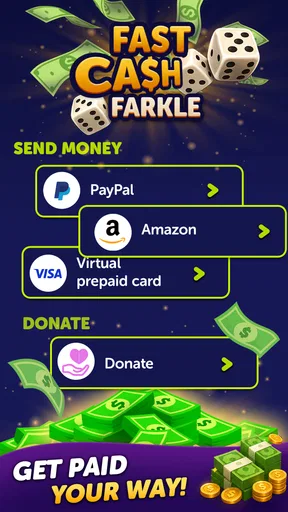




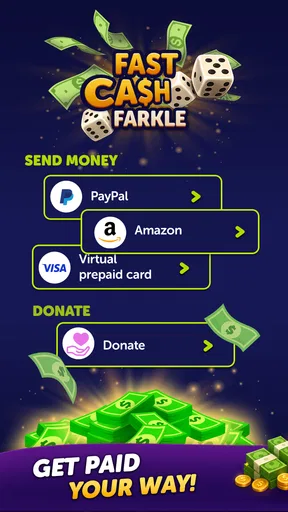


 Analysis by AppCompare
I can see Fast Cash Farkle working best as a small, shared-device diversion: someone has a few spare minutes, passes over the phone, and the next person gets a turn with the dice. That casual appeal comes with a meaningful wrinkle, though. This is a money-prize game, not just a digital Farkle set, so I would treat it differently from a family puzzle or a no-stakes dice app. Whether it fits your household depends on who is using the device, how you handle accounts and spending, and whether everyone is comfortable with cash-prize play.
A short break, not a whole evening
In an everyday setting, I can imagine opening it while waiting for a takeaway order or sitting through a quiet stretch between errands. A few turns can give that pause a clear focus: decide whether the roll is worth the risk, then stop when the moment is over. That makes it easier to fit around a busy day than a game that expects a long uninterrupted session. I would still choose a sensible stopping point before opening it, because the competitive prize framing can make “one more turn” feel more tempting than it does in a purely casual dice game.
For a group, the best use is probably watching and chatting rather than treating the phone as a table game everyone can freely operate. One person can play while others react to the decisions, but the active player should make the calls. That keeps the session light without confusing who controls the account or who is responsible for a purchase prompt.
Good for quick turns, less suited to casual pass-and-play
Fast Cash Farkle is a casual game from GreatPlay App built around rolling dice, making decisions, and competing for cash prizes. Farkle’s familiar appeal is its push-your-luck tension: a roll can add to your score, but continuing rather than banking a result can put progress at risk. That makes each turn more thoughtful than a simple tap-through game, even when a round fits into a short break.
I like the idea of it for a solo pause—waiting for a ride, taking a break, or filling a few idle minutes—because dice decisions are easy to understand without needing a long tutorial or a complicated game world. The cash-prize framing changes the mood, however. I would not hand the phone around as casually as I might with a standard Farkle app, since the experience is tied to competition and may involve purchases.
The game is free to install, while optional in-app purchases range from $0.99 to $49.99 per item. That range makes it sensible to decide in advance whether spending is off-limits, especially on a shared device. A free download does not mean every way of engaging with the game is free, and I would avoid treating a possible prize as a reason to spend more than I intended.
Set expectations before sharing the phone
For a household, the first practical question is not whose turn comes next; it is whose account and decisions are attached to the session. Before letting someone else play, I would check that the person understands they are using a game centered on cash prizes and that any purchase decision belongs to the account holder. Keeping the device owner in charge of payment choices is a simple boundary that avoids awkward surprises.
Worth Reading Before You Choose

EA SPORTS FC Mobile 26 Is a Bigger Football Game, but It Takes Time

Flipboard Shows What News Apps Must Do Beyond the Feed

Switching to Android Auto Means Rethinking Your Driving Routine

Google Calendar Makes a Crowded Week Easier to Manage

Ludo King Makes the Most of the Minutes Between Plans

Baby Panda World Brings Quick Play to Modern Phones, but Its Game Library Feels Busy
I would also avoid assuming that a shared phone creates separate play histories or player identities. If people want to take turns, agree on a clear handoff rather than relying on the app to distinguish household members. That is especially useful when one person is only trying a round and another intends to continue playing later. A quick verbal check—“Are you done, and should I leave the game as it is?”—can prevent accidental changes or confusion.
This is a practical distinction from ordinary pass-and-play games. With a conventional dice app, handing over the device mainly changes who is tapping. With a prize-oriented game, the person playing should also know what choices they are making and whose account is involved. If your household prefers games where every person can join without account or spending questions, a traditional offline Farkle game is likely the easier fit.
Coordinate turns without assuming shared controls
Farkle naturally invites people to comment on a risky roll, but that can blur the line between watching and making the decision. I would let the active player choose whether to keep rolling or stop, rather than having several people call out instructions. That keeps the game’s central trade-off—protecting a score or risking it for more—clear and makes a shared session feel fairer.
A useful routine is to decide before starting whether the phone is for one person’s session or a group’s informal turn-taking. If it is the latter, agree on when a turn ends and who is responsible for any account-related choices. This is not a substitute for separate accounts or household settings; it is simply a way to avoid treating a prize game like a communal toy when the underlying play may be personal.
I would also keep commentary grounded in the game rather than promising that a good decision will produce a payout. Dice outcomes are uncertain, and strategic choices can improve how deliberately someone plays without guaranteeing a result. That distinction matters if younger or inexperienced players are watching: the skill element should not be presented as certainty about winning money.
Age, trust, and the cash-prize framing
The game carries a Mature 17+ age rating, which is an important household boundary rather than a detail to overlook. I would not treat it as a general-audience game for children just because dice are familiar. The money-prize focus changes what a parent or device owner should consider, and the age rating is a clear reason to make the decision deliberately.
Trust also means being honest about what the game is and is not. Its store summary presents Farkle play for cash prizes, but that should not be taken as a promise of income or a dependable way to earn money. I would approach it as entertainment with a prize element, not as a side job or a reliable financial plan. Anyone uncomfortable with that distinction will probably enjoy ordinary Farkle more.
The title has a 4.9 average from around 6,200 ratings, with about 500 written reviews and over 50,000 installs. Those figures suggest that many players have responded positively, but they cannot tell me whether a particular household will be comfortable with prize-focused play. I put more weight on the age rating, spending boundaries, and each player’s expectations than on popularity when deciding whether it belongs on a shared device.
What to expect from the game itself
For someone who already knows Farkle, the appeal is the familiar decision loop rather than a large collection of modes or a sprawling progression system. You roll, judge the risk, and decide whether to press on. That creates compact moments of suspense, but it can also feel repetitive if you want a story, exploration, or a broad variety of activities. Players seeking those things would be better served by a different casual game.
Compared with a standard free dice game, Fast Cash Farkle has a more consequential framing because prizes and purchases are part of its identity. Compared with a full board-game night, it is lighter and easier to pick up, but it cannot replace the social give-and-take of everyone gathering around a table. I see it as a focused option for people who specifically enjoy Farkle and want a competitive cash-prize context—not as the default choice for every person who likes casual games.
It is listed as free, with in-app purchases priced from $0.99 to $49.99 per item, so I would look at the purchase prompts carefully and make a personal spending limit before playing. If you are sharing a device, do not assume that another person will make the same spending choices you would. For a household that wants no purchase questions at all, an offline dice app is a cleaner alternative.
The current version is 1.0.26337, and the stated minimum operating-system requirement is 8.1. The release date is Aug 6, 2026. Those details are useful when checking whether an older device is a match, but compatibility alone should not decide whether it is suitable for a shared household. The age rating and cash-prize angle deserve equal attention.
Choosing the right person to play
I think the strongest fit is an adult who already knows the basic rhythm of Farkle and enjoys weighing a safe score against another risky roll. Familiarity helps because the pleasure is in making that decision, not in discovering an elaborate set of systems. Someone who wants quiet, solitary play can keep the session personal; someone who enjoys an audience can let friends watch without handing over the device.
I would skip it for a household looking for a child-friendly game, a completely consequence-free way to pass a phone around, or a reliable income source. It is also a weaker choice for players who dislike repeated luck-based turns or prefer games with a clear narrative and varied objectives. In those cases, a no-stakes dice game, a physical set of dice, or a broader casual game is a better match.
One practical tip is to decide what “done” means before a session begins: a short break, a set number of turns, or simply stopping when attention drifts. This does not change the game; it helps keep a quick diversion from expanding into an unplanned stretch. I would also treat a purchase prompt as a pause point, not as a cue to act quickly. Read the choice, check whose account is active, and only proceed if the account holder intended to spend.
My household verdict
I would recommend Fast Cash Farkle to an adult who already enjoys Farkle, likes making quick risk-and-reward decisions, and is comfortable keeping prize play separate from any expectation of steady earnings. Its casual format can suit a short break, and its dice-based decisions give each turn more texture than a purely automatic time-killer. I would be more cautious about installing it on a device that children routinely use or passing it around without explaining the prize and purchase context.
For shared use, my advice is simple: keep the account holder in control, make spending boundaries explicit, and let the active player own the decisions in their turn. If that sounds like too much coordination for a casual game, choose a no-stakes Farkle alternative instead. If everyone using the device meets the age requirement and understands the boundaries, Fast Cash Farkle can be an enjoyable, focused way to play a familiar dice game—just one I would keep personal and intentional rather than treating it as an unrestricted family pastime.
Pros
- Quick rounds make it easy to play during short breaks.
- Simple dice-rolling rules are approachable for new players.
- Risk-and-reward choices add tension to each turn.
- A compact format keeps the focus on the dice and score.
- Works well as a casual
- lightweight game experience.
Cons
- Luck can outweigh strategy
- which may frustrate some players.
- Repeated rolls and scoring can feel monotonous over time.
- Risky turns can erase progress and lead to abrupt setbacks.
- The game may offer limited variety for long play sessions.
- Fast-paced decisions can be unforgiving for new players.
FAQs for Fast Cash Farkle
What is Fast Cash Farkle?
Fast Cash Farkle is a mobile dice game built around Farkle, a game in which players roll dice, set aside scoring combinations, and decide whether to roll again or bank their points. Its “Fast Cash” name may suggest cash-prize features, but availability and rules can depend on the version, location, and current app policies. Check the listing and in-app terms before downloading, especially if you expect real-money rewards.
How do you play Fast Cash Farkle?
The basic Farkle format is straightforward: roll the dice, choose scoring dice or combinations, and then either stop to secure your turn’s points or risk another roll for a higher score. A roll with no scoring dice may cause you to lose the points accumulated during that turn. Fast Cash Farkle may add its own modes, entry requirements, or scoring rules, so read the tutorial and match instructions rather than assuming every detail matches other Farkle games.
Can you win real money or prizes in Fast Cash Farkle?
Do not assume that playing Fast Cash Farkle guarantees cash or prizes. Reward systems, if offered, may be limited by eligibility, region, account status, minimum withdrawal amounts, or other conditions described by the developer. Some games use virtual coins or promotional rewards that cannot be withdrawn as cash. Review the app’s official rules, payment information, and withdrawal terms before spending money or sharing financial details, and never treat gameplay rewards as guaranteed income.
Is Fast Cash Farkle free to download, and does it include in-app purchases?
The download may be free, but that does not necessarily mean every feature or match is free to use. Depending on the current version, the app may offer optional purchases, ads, virtual currency, or paid entry features. Check the Google Play or Apple App Store listing for pricing and in-app purchase disclosures, then review the in-game purchase screen carefully. If children may use the device, consider enabling purchase restrictions and checking the app’s age rating.
What should I check before downloading Fast Cash Farkle?
Before installing, confirm that the app is available in your country and that your device meets the store’s requirements. Review the developer name, recent update date, user reviews, privacy information, and requested permissions; these details can change over time. Also check whether the app requires an account, an internet connection, or location verification, and whether its cash-related features are offered where you live. Download only from an official app store and read the applicable terms.


